If you’ve spent any time in bookstores, on BookTok, or scrolling reading recommendations online, you’ve probably noticed one thing: spice is everywhere. From Young Adult (YA) edging into New Adult (NA), to nearly every corner of the romance genre, explicit scenes have become more common—and more expected.
Before I go any further, I want to be clear about one thing: this isn’t a judgment. People love what they love, and there’s room on the shelves for all kinds of stories. Spice resonates deeply with many readers and writers, and that’s valid.
So why did I choose a different path?
When I made the decision to take my passion for writing seriously and step into the role of author, I also made a quiet promise to myself: I didn’t want spice in my books. Not because it can’t be meaningful. But because it isn’t how I want to tell stories.
I wanted to share that decision—not to convince anyone, but to peel back the onion a little and let you know me better as a writer.
Choosing Emotional Connection Over Explicit Detail
The biggest reason comes down to emotional connection.
This might sound surprising to some, because intimacy and spice can absolutely coexist with deep emotion. But for me, explicit scenes often pull focus away from the slow, quiet build that I love most in romance: the banter, the tension, the unsaid feelings, the moments where two characters are circling each other long before they ever touch.
I’m drawn to the kind of intimacy that’s felt rather than described. The kind that lingers. The kind that makes you lean forward in your seat, waiting.
And for me, nothing illustrates that better than Pride and Prejudice.
If you’ve been following me for a while, you know it’s my favorite book—and the 2005 film adaptation is my favorite movie. That story is one of the reasons I wanted to write romance in the first place. There’s something powerful about the restraint, about the longing looks, about the tension that simmers just beneath the surface.
One of my favorite moments isn’t even in the book—it’s a small, improvised action in the film: Darcy reaching out to help Elizabeth into the carriage, his hand hovering, then flexing afterward as if startled by his own reaction. No words. No kiss. No explicit anything. And yet… it still makes me swoon.
That moment works because of everything that came before it. Because a single touch, when earned, can deliver a massive emotional payoff.
That’s the kind of romance I want to write.
Small Moments, Big Impact
I believe there’s something special about letting small actions carry big weight. A glance held too long. A hand brushing another. A pause before a name is spoken.
Those moments invite the reader to participate—to feel the tension instead of being told exactly what’s happening. They ask you to read between the lines. And when the connection finally clicks, it feels personal.
For me, explicit scenes often close that space instead of opening it.
Writing for a Wider Audience
Another major reason I chose not to include spice is accessibility.
I love writing strong female characters—women who may not fully know their worth or strength at the beginning of the story, but slowly grow into it. Their journeys matter to me deeply. And I want those stories to be available to a wide range of readers.
I especially love the idea of younger readers, ages 14 and up, finding these books and seeing characters they can point to and say, If she can do that, maybe I can too.
That’s also why I personally believe spice doesn’t belong in Young Adult. YA is a space for discovery, growth, identity, and possibility. For me, keeping my stories closed-door allows younger readers to engage with romance without being pushed into content they—or their parents—may not be ready for.
At the same time, I want adult readers to feel just as welcome. Romance doesn’t lose its depth or intensity just because it fades to black. Sometimes, the anticipation is the point.
Faith, Storytelling, and Safe Space
There’s one more layer to this choice that I want to acknowledge, because it’s part of who I am as a writer.
As a devout Catholic, my faith naturally shapes how I see relationships, love, and commitment. That doesn’t mean I’m interested in using fiction to make moral arguments or to question anyone else’s choices. I’m not. My goal has never been to write stories that police behavior or draw lines in the sand.
Instead, my faith nudges me toward focusing on relationship-building—the trust, the respect, the emotional growth between two people—rather than centering a story around physicality. I want the romance to feel safe, welcoming, and rooted in connection first.
For me, that creates space. Space for readers of different ages, backgrounds, beliefs, and comfort levels to step into the story without feeling excluded or judged. Romance is still very much there—but it’s wrapped in intention, tenderness, and room to breathe.
A Choice, Not a Statement
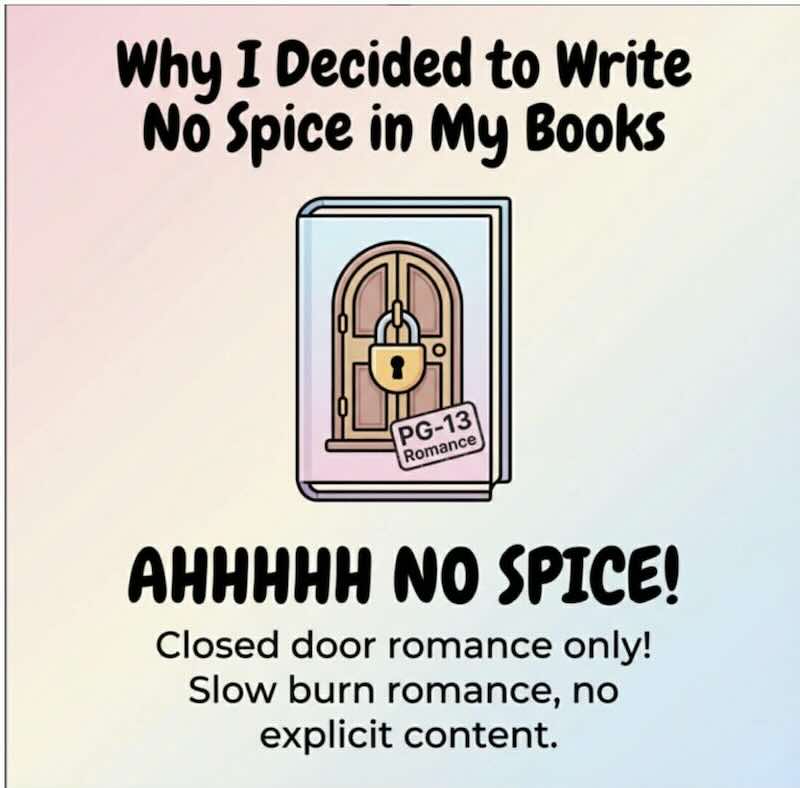
At the end of the day, writing without spice is simply a creative choice—one that aligns with how I experience romance, connection, and storytelling.
There is room for all kinds of books. There are readers who crave spice, and readers who crave slow burns, and readers who love both, depending on the mood. None of those preferences cancel each other out.
This is just where I plant my flag.
If you’re someone who loves emotional tension, quiet moments that speak loudly, and romances built on connection first—I hope my stories feel like home.
And if not? That’s okay too. The beauty of books is that there’s always another story waiting for you.
I’m curious—what makes a romance story feel meaningful to you? Is it the chemistry, the emotional journey, the slow burn… or something else entirely?
XOXO,
LK????